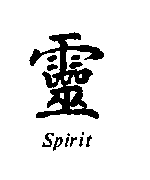
The Holy Spirit
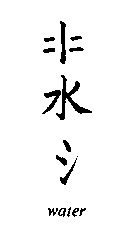

The Bible teaches that the Spirit of God “brooded” or “hovered” over the face of the waters before the creation of land (Genesis 1:2). The character for “water” is turned on its side and combined with the character for “cover” — giving the idea that the Spirit of God covered, or hovered over, the face of the waters.

Notice how similar this combination becomes to the word for “rain.” In Scripture, rain often pictures how God pours out His Spirit upon the earth: “…I will pour out My Spirit upon all flesh” (Joel 2:23, 28).
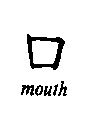
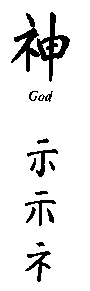
In the middle of the “Spirit” character, the character for “mouth” or “person” is repeated three times — reflecting the Trinity. When God says, “Let us make man in our image,” He speaks in a special plural denoting at least three: Father, Son, and Spirit. Even in characters 700 years older than the Hebrew of the Old Testament, the Trinity is revealed.
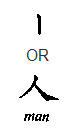
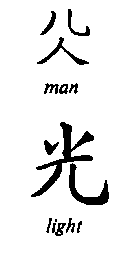
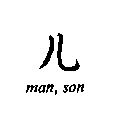
Here are two forms of the character for “man.” The lower, most common form shows a short trunk and two legs; when used inside another character it is sometimes abbreviated to a single vertical line, as in the upper form.

In the character for “work,” the top line represents heaven and the bottom line earth, with a man (the abbreviated form) working in between.

Here three persons are working — two with the normal character for person, the third the abbreviated form. They are the three “mouths” seen earlier. Combined, they mean “worker of miracles.” Indeed, when Father, Son, and Holy Spirit work together as One, miracles happen!

So the Holy Spirit covered the waters of the earth in creation, pours out His blessings upon Christians, is one Person of the Trinity, and is a worker of miracles — a wonderful description taken straight from the Chinese character.
Other Instances of the Trinity

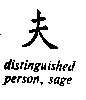
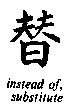
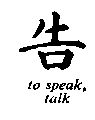
The first character means a “distinguished person”; the second, a tongue inside a mouth, means “to speak.” Combined into the character for “substitute,” they render “one speaking on behalf of two others.” In the New Testament, Jesus Christ represents the other two Persons of the Godhead.
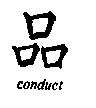
The character for “conduct” holds another Trinitarian idea: the ancient Chinese believed a wise word spoken by three mouths of authority was to be a rule of conduct. So God’s Word, spoken by Father, Son, and Holy Spirit, is the ultimate rule for our lives.